 ultimate-guide
Digital Marketing for Local HVAC: 2026 Growth Guide
Table of Contents
- Why Local HVAC Marketing Looks Different in 2026
- Local SEO for HVAC Contractors: Own the Map Pack
- HVAC Pay-Per-Click Advertising Costs and How to Control Them
- Email Marketing Templates for HVAC That Fill the Off-Season
- Website and Landing Page Conversion: The 2% vs 15% Gap
- AI-Driven Customer Service and Post-Installation Marketing
- How to Track ROI and Prove Your Local HVAC Marketing Works
- Conclusion
- Frequently Asked Questions
Last Updated: September 14, 2026
Why Local HVAC Marketing Looks Different in 2026
The ground has shifted under local service marketing, and most HVAC contractors haven't adjusted. According to BrightLocal's 2026 local consumer review survey, 45% of consumers now use AI tools to find local services, up from just 6% the previous year. That single jump changes how homeowners discover contractors, compare them, and decide who to call. This guide from Real Web Marketing Inc. breaks down what digital marketing for local HVAC actually looks like now, from local SEO and PPC costs to email templates that keep revenue flowing in the off-season. Below, we'll show you exactly where to spend, what to fix first, and how to prove it's working.
Local SEO for HVAC Contractors: Own the Map Pack
Local SEO for HVAC contractors means optimizing your Google Business Profile, service area pages, and review signals so you appear in the map pack and AI-generated local answers. It's the highest-ROI channel for most contractors because it targets homeowners ready to book.
Google Business Profile Signals That Move Rankings
Google weighs proximity, relevance, and prominence. You can't change where a searcher stands, but you control the other two: complete every field, add real photos of your trucks and technicians, and post weekly. Review velocity matters more than total count, a steady flow of fresh reviews beats a pile of old ones.
Service Area Pages and Review Thresholds
Build one page per city or service zone, each with local job examples and a clear call to action. Duplicate content across pages gets ignored. Review thresholds are tightening too; PipelineOn's home service marketing data notes that paid lead costs are rising while review minimums climb, meaning thin profiles lose visibility fast.
HVAC Pay-Per-Click Advertising Costs and How to Control Them
HVAC pay-per-click advertising costs vary widely by market, but you control the outcome through budget structure, not luck. Home services contractors currently allocate 35-40% of digital spend to Google Ads and 15-20% to Google Local Services Ads, according to Valve+Meter's home services statistics. The mistake most contractors make is spreading budget evenly instead of concentrating it.
Budget Tiers: Where Every Dollar Should Go
| Monthly Budget | Google Ads | Local Services Ads | Local SEO | Best For |
|---|---|---|---|---|
| Under $2,000 | 60% | 25% | 15% | Single-market contractors |
| $2,000-$6,000 | 50% | 20% | 30% | Multi-city service areas |
| $6,000+ | 45% | 20% | 35% | Established regional brands |
Local Services Ads charge per verified lead, making them safer for emergency-intent searches. Google Ads wins on high-value installs and replacements where you can afford a higher cost per acquisition. One campaign we reviewed generated 26.6 conversions on $1.73K in ad spend in a single market, tight geo-targeting beats broad reach.
Email Marketing Templates for HVAC That Fill the Off-Season
Email marketing templates for HVAC work best when they target maintenance, not sales. The off-season slump happens because contractors stop communicating once the weather cooperates. A simple sequence keeps your brand visible and books tune-ups before the rush.
Segment Before You Send
One list, one message is the fastest way to get ignored. Split your contacts into at least four groups:
- Active customers (job completed in the last 12 months), highest open rates, best service-agreement candidates.
- Lapsed customers (no job in 18+ months), win-back offers and a "we've upgraded our diagnostics" angle.
- Service agreement members, priority scheduling, seasonal reminders, referral asks.
- New leads who never booked, a short nurture sequence with one clear offer.
Segmentation matters: a tune-up reminder sent to someone who replaced their system last month reads as spam, and a win-back email to a customer who just paid reads as tone-deaf. Even a two-segment split (customers vs. non-customers) lifts engagement noticeably over a single broadcast list.
The Mechanics That Decide Whether Anyone Sees Your Email
Deliverability is a sender-reputation problem, not a design one. Three things move the needle:
- Authenticate your sending domain. Set up SPF, DKIM, and DMARC records. Major inbox providers now treat unauthenticated bulk mail as suspect by default.
- Warm up new sending domains. If you switch from a shared marketing platform to your own domain, ramp volume over two to three weeks rather than blasting your full list on day one.
- Honor opt-outs immediately. The CAN-SPAM Act requires a working unsubscribe mechanism, a physical mailing address in the message, and accurate subject lines. Non-compliance carries real penalties, and inbox providers penalize complaint rates fast.
Contractors often blame "email doesn't work" when the real issue is an unauthenticated domain and an uncleaned list. Remove hard bounces and anyone who hasn't opened in 12 months before your next send.
A Four-Email Off-Season Sequence That Books Tune-Ups
Use this framework, adjusted to your season:
- Email 1 (Day 1): "Your system's pre-season check" with a booking link. Subject line: Is your AC ready for summer?
- Email 2 (Day 5): "What we found on 40 local systems this month" with one real photo and a soft CTA. Real job photos outperform stock imagery in this category.
- Email 3 (Day 12): "Service agreement reminder" offering priority scheduling for members.
- Email 4 (Day 21): "Last call before the rush" with a deadline and a single booking link. Deadlines work; vague urgency does not.
Service Agreements Are the Real Prize
Service agreements convert one-time customers into recurring revenue and lift lifetime value without new ad spend. A customer who books two tune-ups a year and calls you first when the compressor fails is worth several times a one-time repair customer. Existing customers cost far less to convert than cold traffic, which is why email delivers the best ROI in this channel.
The upsell belongs in the email, not just on the invoice. A member-only priority window during peak season is a benefit customers understand immediately, and it costs you nothing to offer.
Website and Landing Page Conversion: The 2% vs 15% Gap
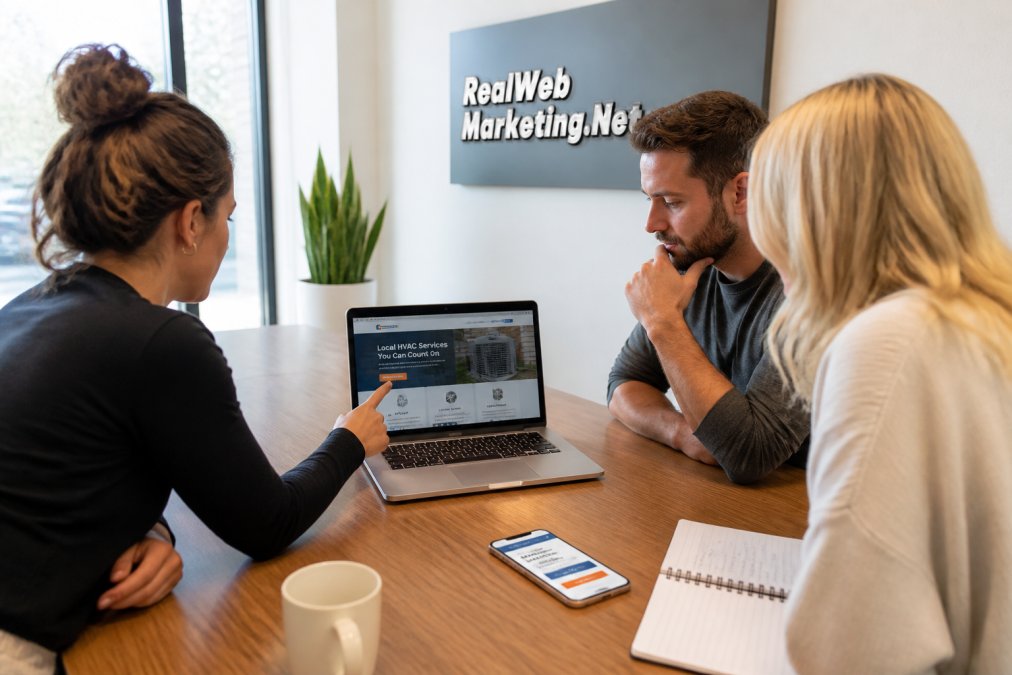
Most HVAC websites convert at 2-4%, while top performers hit 10-15% on emergency-intent pages, based on Webtonic's 2026 HVAC digital marketing statistics. That gap isn't about design taste. It's about what loads first and what the visitor sees in the first three seconds.
A mobile-friendly website with a click-to-call button above the fold, a booking form that takes under 30 seconds to complete, and trust signals like reviews and license numbers will outperform a prettier site every time. Landing page optimization for paid traffic means one page, one offer, one action. Send PPC clicks to your homepage and you'll pay for the privilege of confusing people.
Schedule a Free Consultation →
AI-Driven Customer Service and Post-Installation Marketing
Two areas competitors consistently ignore are AI-assisted customer service and post-installation marketing. Both are cheap relative to paid acquisition and compound over time. Most guides stop at lead generation; the money in HVAC is in what happens after the first call and after the install.
AI Tools That Actually Fit an HVAC Business
AI in home services isn't a replacement for your dispatcher, it's a safety net for the hours your office is closed and the calls your team can't pick up. The practical use cases are narrow:
- After-hours booking. A chat widget or voice agent that captures name, address, system type, and preferred window, then drops the lead into your CRM or sends a text to the on-call technician. This captures leads that would otherwise hit voicemail and call the next company on the list.
- FAQ deflection. Common questions, service windows, diagnostic fees, whether you service a particular brand, get answered instantly, which frees your CSR to handle scheduling and objections.
- Emergency triage. Scripted questions ("Is there a gas smell? Is the unit completely dead?") route true emergencies to a human immediately and queue routine requests for the morning.
- Review requests and follow-ups. Automated texts or emails triggered by a completed job, timed to land while the customer is still happy.
Contractors often over-buy: they sign up for a platform with a dozen AI features and use two. Start with after-hours capture and review requests, those two alone justify the cost for most single-market contractors.
Post-Installation Marketing: The Revenue Most Contractors Leave on the Table
The job isn't finished when the truck leaves. A new install is the best moment to sell a maintenance plan, because the customer just made a large commitment and wants the equipment to last. Yet most contractors send one invoice and go quiet.
Build a post-installation sequence that runs on a schedule:
- Day 1: Thank-you message with the technician's name, a photo of the completed work, and a warranty registration link.
- Day 3: Review request. Ask for the review while the experience is fresh, and make the link one tap.
- Day 14: Maintenance plan offer. Frame it around protecting the warranty and avoiding emergency repair costs, not around a discount.
- Month 6: Check-in with a seasonal reminder and a booking link for the next tune-up.
- Month 12: Anniversary message with a member-only scheduling window.
Automated scheduling and reminder emails do most of this work. Every install becomes a recurring relationship instead of a one-time transaction.
Why This Compounds
Acquisition costs are rising across paid channels, making retention the cheapest growth lever available. A customer on a maintenance plan generates predictable annual revenue, refers neighbors, and calls you first when something breaks. Contractors who build the post-installation sequence once and let automation run it see service-agreement attach rates climb steadily over a few quarters, without additional ad spend.
AI and post-installation marketing aren't separate initiatives. The same automation that captures an after-hours lead can trigger the day-one thank-you, day-three review request, and month-six reminder. Set it up once, and the system works the off-season for you.
How to Track ROI and Prove Your Local HVAC Marketing Works
Proving ROI starts with call tracking and form attribution, not vanity metrics like impressions. Set up a unique tracking number per channel, tag every form with its source, and reconcile leads against closed jobs monthly.
Here's the workflow we recommend:
- Assign a tracking number to Google Ads, Local Services Ads, and organic separately.
- Log every lead with its source in your CRM or a simple spreadsheet.
- Match leads to booked jobs and revenue at month-end.
- Calculate customer acquisition cost per channel.
- Shift budget toward the channel with the lowest cost per booked job.
The HVAC industry is projected to grow 12.7% from 2024 to 2028, per WebFX's HVAC marketing statistics, so demand isn't the problem. Visibility and measurement are. Contractors who track cost per booked job instead of cost per click make better decisions within 60 days.
Conclusion
The contractors winning local search in 2026 aren't outspending anyone; they're measuring what matters and fixing the leaks first. Real Web Marketing Inc. helps HVAC and service businesses do exactly that, with hands-on SEO, PPC management, and web design backed by transparent monthly reporting and direct access to experienced marketers. Get started with Real Web Marketing Inc. and turn your digital presence into a predictable source of booked jobs.
Frequently Asked Questions
What is the best way to advertise my HVAC services on a local budget?
Start with your Google Business Profile, then layer paid search. Google Ads takes 35-40% of digital spend for home services contractors, while Google Local Services Ads take 15-20%, according to Valve+Meter's 2026 data. For a lean budget, prioritize Local Services Ads first because you pay per lead, then add Google Ads for emergency keywords like 'AC repair near me.' A local HVAC marketing plan built around these two channels plus review collection typically outperforms broad social campaigns for booked service calls.
How can HVAC companies improve their local SEO rankings?
Three moves matter most. First, complete and update your Google Business Profile weekly with photos, services, and posts. Second, build service area pages for each city or zip code you cover, with unique content rather than templated copy. Third, keep reviews flowing, since review thresholds are tightening in 2026 according to PipelineOn. Local SEO for HVAC contractors also depends on consistent name, address, and phone data across directory listings. Most contractors see movement in local search rankings within 60-90 days of fixing these basics.
What do HVAC pay-per-click advertising costs actually look like in 2026?
Costs depend on your market, competition, and campaign structure, so there is no single number. What matters more is efficiency: one documented HVAC Google Ads campaign generated 26.6 conversions on $1.73K in ad spend. Home services contractors now allocate 35-40% of their digital budget to Google Ads and 15-20% to Local Services Ads. Track cost per booked call, not cost per click, and set a target customer acquisition cost before you launch.
How do I track the effectiveness of my digital marketing for local HVAC?
Use call tracking numbers on every channel, UTM-tagged landing pages, and a simple CRM that logs lead source. HVAC website conversion rates run 2-4% on average, while top performers hit 10-15% on emergency-intent pages, so benchmark against that range. Review your return on investment monthly: leads by source, cost per lead, and booked jobs. Transparent monthly reporting from your marketing partner should show exactly where every dollar went, not just traffic totals.